
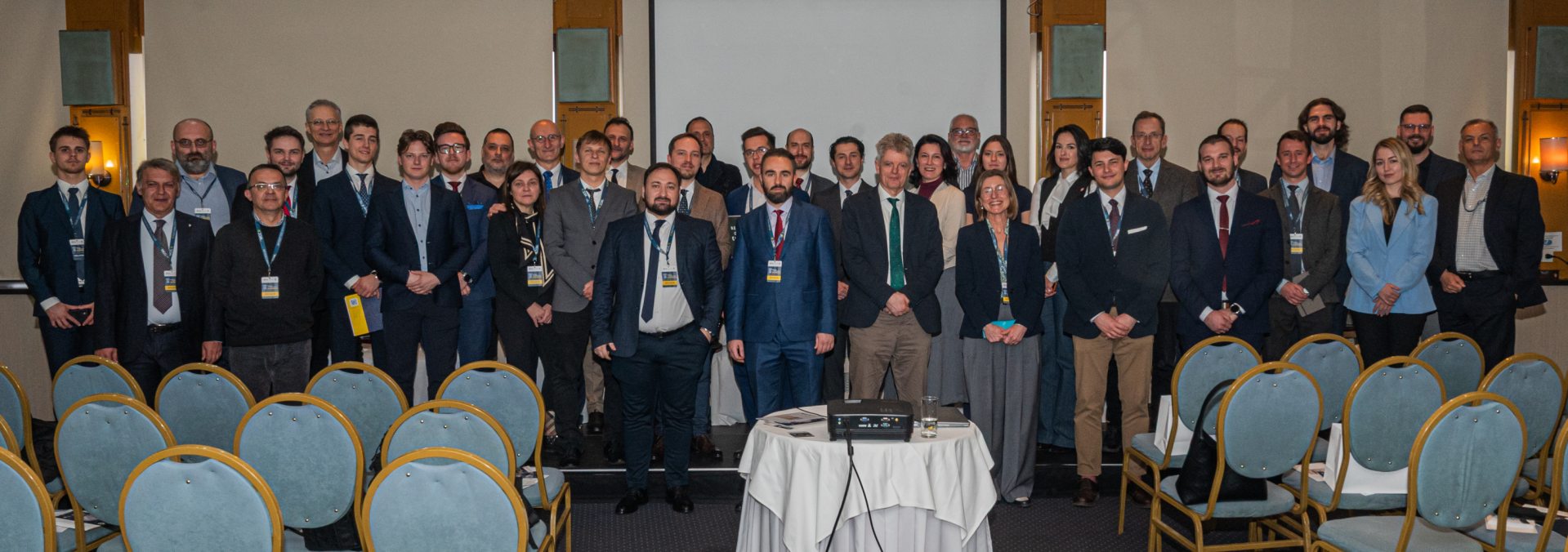
At the nearly 80-person event, 25 experts from 11 countries delivered presentations, including participants from Hungary, Serbia, Montenegro, Croatia, Slovenia, Bosnia and Herzegovina, North Macedonia, Turkey, the United Kingdom, and France. The aim of the conference was to initiate an international dialogue on the issues and current state of Balkan conservatism, talent development, and classical education.
Institutional Tradition and CooperationThe conference was opened by Prof. Dragan Stanić, President of Matica Srpska, who emphasized in his speech the historical significance of the institution, which celebrates its 200th anniversary this year. He pointed out that Matica Srpska served as a model for many other Slavic cultural institutions in the 19th century and continues to play a defining role in cultural and scientific life today. Special attention was given to Letopis Matice srpske, which, after the Yale Review, is the second oldest continuously published journal in the world.
This was followed by a speech from Dr. Milán Constantinovits, Director for Professional and Educational Affairs at MCC. In his address, he emphasized that for Central Europe, education—particularly talent development—is a key issue closely linked to the region’s historical experiences and contemporary challenges. He highlighted that historical struggles for national identity, the legacy of communism, and the current crisis of European identity all call for joint reflection on the future of education. In this context, talent development is not merely an individual matter but a strategic response to the erosion of cultural traditions, technological challenges, and the outmigration of talent.
Conservatism and EducationThe first lecture was delivered by Dr. Miša Đurković, head of the Geopolitical Workshop at MCC–MKI and project lead at Matica Srpska, who spoke about the challenges facing conservative thought in the Balkans. He emphasized the importance of cooperation, particularly in strengthening connections between regional higher education institutions.
Dr. Joanna Williams, presenting the international volume Reclaiming Classical Education published by MCC, interpreted education as a moral project and stressed the importance of transmitting cultural heritage. In her speech, she highlighted several pressing issues in the United Kingdom, including the growing number of young people who believe they suffer from mental health problems, and the significant proportion of Generation Z who claim they would not fight for their country in the event of a conflict. In her view, both problems are exacerbated by current attitudes toward education, which could be mitigated by introducing a more classical curriculum.
Dr. János Setényi’s presentation analyzed the possible courses of action within conservative education policy. He began by outlining the characteristics of international conservative education, then pointed to symptoms of crisis in Western education systems, including declining standards, weakening teacher authority, and structural issues.
As a solution, he proposed three possible strategies for conservative actors: withdrawal (“escapism”), individual-level institutional struggles, and active participation in policymaking. His central argument was that it is crucial for conservative actors to move beyond individual strategies and become strategic participants in education policy decision-making.
Panel I: Conservatism in the Balkans Participants:
Dr. Miša Đurković – MCC–MKI Geopolitical Workshop
Dr. János Setényi – MCC Learning Research Institute
Prof. Dr. Suay Nilhan Açıkalın – Ankara Hacı Bayram Veli University (Turkey)
Prof. Tihomir Cipek – Institute of Political Science, Catholic University of Croatia (Zagreb)
Dr. Fedja Pavlović – University of Podgorica (Montenegro)
Prof. Žiga Turk – former Minister of Education (Slovenia)
Neven Djenadija – political analyst, University of Banja Luka (Bosnia and Herzegovina)
The first roundtable discussion examined the opportunities and limitations of Balkan conservatism. Participants emphasized that the political and historical diversity of the region fundamentally shapes the scope of conservative thought.
One of the key takeaways was that opportunities vary significantly from country to country: while in some contexts conservative actors benefit from more favorable institutional environments, in others their room for maneuver is considerably more limited.
Particular attention was given to the case of Bosnia, whose unique political situation diverges from traditional nation-state models and presents distinct political and identity-related challenges.
Panel II: Talent Development and Elite EducationParticipants:
Dr. Milán Constantinovits – Mathias Corvinus Collegium
Bernard Zeneli – expert in governance, education, migration, and youth policy
Prof. Vladimir Božović – Rector, University of Podgorica (Montenegro)
Prof. Igor Lukšič – former Minister of Education (Slovenia)
Admir Lisica – Geopolitical Research Center, Sarajevo (Bosnia and Herzegovina)
Dr. Željka Buturović – Institute of Social Sciences, Belgrade (Serbia)
Dr. Srđan Šljukić – Faculty of Philosophy, University of Novi Sad (Serbia)Moderator: Mátyás Kohán – journalist, Mandiner
The panel opened with a presentation by Dr. Milán Constantinovits. He focused on clarifying the concepts of elite and talent. In his interpretation, the elite is not an inherited privilege, but a meritocratically organized intellectual and cultural leadership group whose role is to provide guidance and sustain social dialogue.
He emphasized that talent development operates on a community-based foundation: it is not merely about fostering individual performance, but about creating an environment in which young people inspire one another and, by taking responsibility, contribute to the preservation of their community and culture.
The second session focused on talent development and elite education, with particular attention to institutional responsibility and the long-term sustainability of education systems.
Participants discussed key issues such as the social legitimacy of elite education, the relationship between excellence and equal opportunity, and the role of institutions in identifying and supporting talent.
Panel III: Classical Learning and EducationParticipants:
Dr. Richárd Fodor – Learning Research Institute, MCC
Dalibor Jovanovski – Faculty of Philosophy, Ss. Cyril and Methodius University in Skopje
Dr. Mihael Antolović – Teacher Training Faculty, Sombor (Serbia)
Dr. Aleksa Filipović – Institute for European Studies, Belgrade (Serbia)
Dr. Dušan Ilić – Institute for European Studies, Belgrade (Serbia)Moderator: Dr. Áron Fekete – Learning Research Institute, MCC
The third session focused on the role of classical learning in modern education.
The panel was introduced by Richárd Fodor’s presentation, which analyzed the state of history education in Europe. Drawing on the recently published volume Compass to History and Civic Education, he pointed out that in many education systems the role of chronological knowledge and classical historical foundations is declining.
He emphasized that history education plays a key role in maintaining cultural continuity and can be understood as a “dialogue” with the past that helps shape identity and historical consciousness.
He also referred to a 2024 European Parliament resolution that increasingly promotes a transnational approach to history over national narratives—an emerging trend that presents new challenges for education grounded in classical learning.
During the panel discussion, participants highlighted the importance of classical disciplines—particularly history, literature, and philosophy—in intellectual formation.
Special attention was given to the experience of the Serbian Ministry of Education regarding European curriculum harmonization, as well as the “Greek Gifts” program, which explores possibilities for integrating classical content into modern curricula.
Participants agreed that classical learning is not merely about preserving tradition, but can serve as a potential foundation for the future of education.
